

TI-RADS Scores Explained: What TR1 to TR5 Actually Mean
On this page
Your ultrasound report says TI-RADS 4, and you have typed it into a search bar before finishing the page. Here is the short version: TI-RADS is a scoring system radiologists use to describe how a nodule looks, not a diagnosis. A TR4 nodule is far more likely to be benign than cancerous. What the score actually decides is whether you need a biopsy next.
What TI-RADS Actually Is
ACR TI-RADS — the Thyroid Imaging Reporting and Data System from the American College of Radiology — standardises how thyroid nodules are described on ultrasound. Before it existed, one radiologist might call a nodule “suspicious” and another “probably benign” for the same images. TI-RADS replaces that with a point score based on five features: composition, echogenicity, shape, margin, and echogenic foci.1
The points add up to a level from TR1 to TR5. The level, combined with the nodule’s size, produces a recommendation: biopsy, follow-up ultrasound, or nothing further. That is the whole purpose of the system. It sorts nodules for further testing. It does not diagnose cancer, and it cannot.
What Each Level Means
Benign
Benign
A simple cyst or a spongiform nodule. These are recognised as benign on appearance alone.
Next step: No biopsy, at any size.
Not suspicious
Not suspicious
Nothing in the appearance raises concern. Reported cancer rates in this group are around 1–2% or lower.2
Next step: No biopsy, at any size.
Mildly suspicious
Mildly suspicious
One mildly concerning feature. Reported cancer rates cluster around 3–5%, meaning roughly 19 in 20 of these nodules are benign.2,3
Next step: Biopsy if 2.5 cm or larger. Follow-up ultrasound if 1.5 cm or larger.
Moderately suspicious
Moderately suspicious
The most common category, and the one that sends most people searching. Reported cancer rates vary across studies from about 5% to 9%, so the great majority of TR4 nodules turn out benign.2,3
Next step: Biopsy if 1.5 cm or larger. Follow-up ultrasound if 1 cm or larger.
Highly suspicious
Highly suspicious
Several concerning features together. This is the category where cancer risk rises meaningfully — reported rates range widely across studies, from roughly 12% to 40%.2,3 It still is not a diagnosis, but it does need a biopsy.
Next step: Biopsy if 1 cm or larger. Follow-up ultrasound if 0.5 cm or larger.
Those cancer percentages differ between published studies because they depend on the population being scanned. A specialist cancer centre sees a different mix of patients than a community clinic. Treat them as general magnitudes, not as your personal odds.
How the Score Is Built
Points come from five categories, and the radiologist adds them up:
- Composition — cystic and spongiform score 0; solid scores the most
- Echogenicity — how bright or dark the nodule looks against surrounding thyroid; very dark (very hypoechoic) scores highest
- Shape — taller-than-wide scores 3 points, because cancers tend to grow across normal tissue planes rather than along them
- Margin — smooth borders score 0; irregular, lobulated, or extension beyond the gland score higher
- Echogenic foci — punctate bright specks, which can represent microcalcifications, score 3
Two nodules can both be TR4 for entirely different reasons. One might be solid but otherwise unremarkable; another might be less solid but taller-than-wide. This is why the level alone does not tell you as much as the full report does.
Where TI-RADS does not apply
The system was designed for adults with an ordinary risk profile. It is not intended for use in children, in nodules that light up on a PET scan, when abnormal neck lymph nodes are present, or in people with known risk factors such as MEN type 2 or previous neck radiation.1 If any of those describe you, the score is not the right tool and your evaluation should not lean on it.
Why Size Changes What Happens Next
The single thing patients most often miss is that TI-RADS level and size work together. A TR4 nodule measuring 1.2 cm and a TR4 nodule measuring 2 cm get different recommendations, because the biopsy threshold for TR4 is 1.5 cm.
The thresholds get lower as suspicion rises: 2.5 cm for TR3, 1.5 cm for TR4, 1 cm for TR5. That is deliberate. Below those sizes, thyroid cancers are generally slow enough that watching carefully is safer than biopsying every nodule in the population — and thyroid nodules are extremely common, present in a large share of adults over 50.
So “TR4, follow-up ultrasound in a year” is not your doctor being casual. It is the protocol working as designed.
If Your Report Says TR4
This is the most-searched of the five, so it is worth being direct. TR4 means moderately suspicious appearance. Most TR4 nodules are benign. What it earns you is a biopsy if the nodule is 1.5 cm or larger, and interval ultrasound if it is between 1 and 1.5 cm.
A biopsy is a fine-needle aspiration — a thin needle, ultrasound-guided, in the office, without general anesthesia. The result comes back as a Bethesda category, which is a separate reporting system with its own numbers. Read what your Bethesda biopsy result means next, because that is the number that actually determines what happens.
One thing worth holding onto: a benign biopsy on a TR4 nodule is a real answer, not a lucky escape. And if that nodule is causing symptoms, being benign is exactly what makes non-surgical treatment possible.
What TI-RADS Does Not Tell You
- It does not diagnose anything. Only a biopsy can tell you what cells are in the nodule.
- It says nothing about thyroid function. A nodule can be TR2 and still be overproducing hormone. That is measured with blood tests, not ultrasound appearance.
- It says nothing about symptoms. A benign TR2 nodule can be large enough to press on your windpipe and make swallowing difficult. Appearance and symptoms are separate questions, and the second one is treatable regardless of the first.
- Scoring varies between readers. Assigning margins and echogenic foci involves judgment, and different radiologists occasionally score the same nodule differently.
- Other systems exist. EU-TIRADS and K-TIRADS use different criteria. If your report came from outside the US, check which system was used before comparing your number to anything here.
Non-Surgical Options at California Thyroid Center
Surgery is not the only route for a thyroid nodule or goiter, and it is often not the first one worth considering. Two image-guided treatments cover most of what we do, and they address different problems.
Radiofrequency ablation (RFA)
A thin probe is guided into the nodule under ultrasound and delivers heat that destroys tissue from within. The body clears it gradually and the nodule shrinks — median volume reduction of roughly 57% at three months, 66% at six, and 71% at twelve in published series. No incision, no general anesthesia, same-day discharge, and the gland stays in place, so most people never need thyroid hormone replacement.
How thyroid RFA worksThyroid artery embolization (TAE)
A catheter is threaded through an artery to the vessels feeding the thyroid, and tiny particles are released to reduce its blood supply. The gland shrinks over the following months. TAE reaches problems RFA cannot: a diffusely enlarged multinodular goiter, a gland too large or too vascular for needle ablation alone, or overactivity from Graves’ disease.
How thyroid embolization worksWhich one suits you depends on whether the problem is one discrete nodule or the whole gland, how large it is, how it behaves on imaging, and what your biopsy showed. Sometimes the answer is neither, and surgery genuinely is the better option — that is a conversation worth having openly. Our comparison chart sets the options against each other, and the clinical evidence page collects the underlying research.
California Thyroid Center
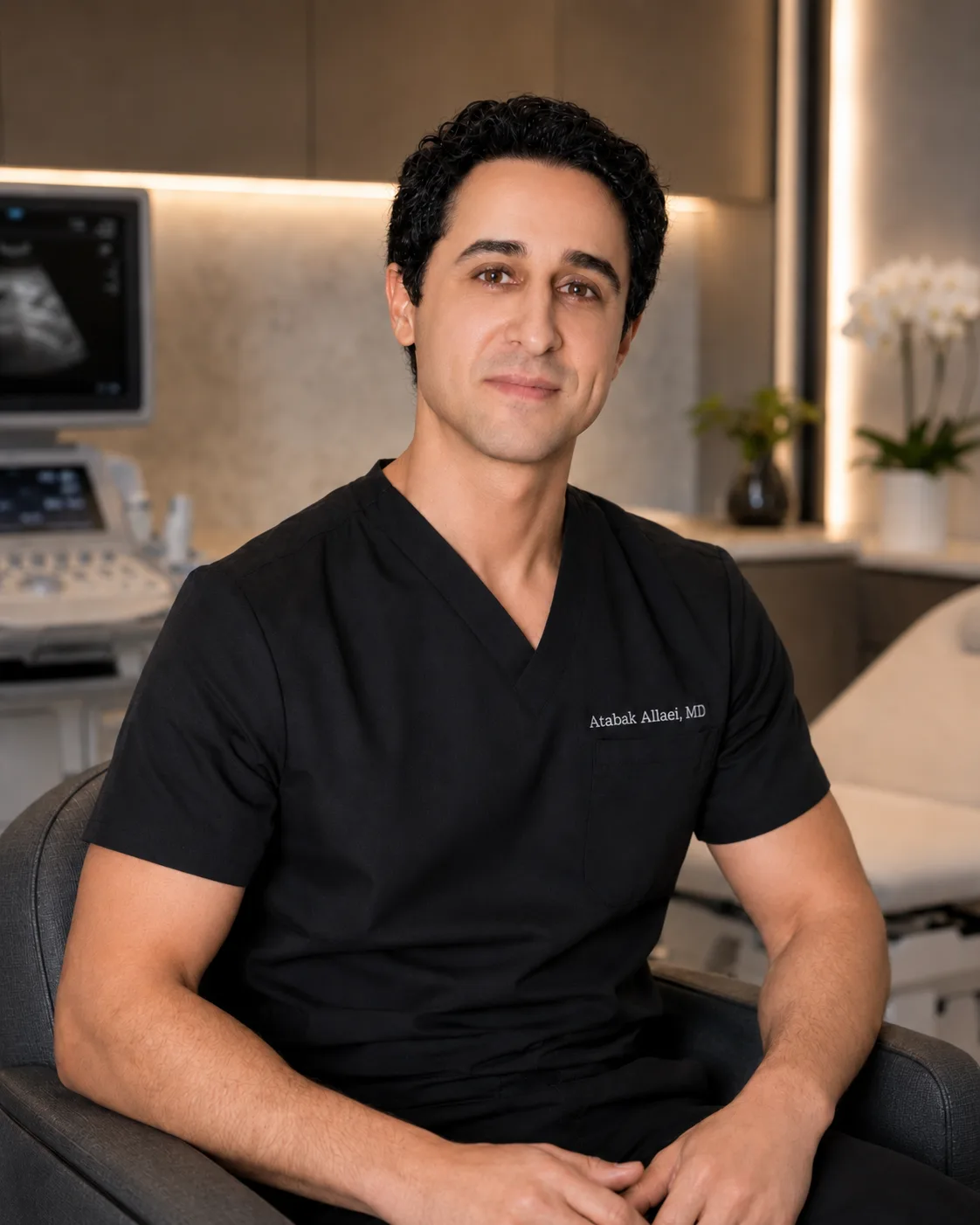
- Double board-certified in Vascular & Interventional Radiology and Diagnostic Radiology
- Attending staff at Cedars-Sinai Medical Center and UCI Health
- More than 5,000 image-guided procedures performed
- Performs both RFA and thyroid artery embolization, including complex and high-risk nodules where position makes ablation technically demanding
Common Questions
Does TI-RADS 4 mean I have cancer?
No. TR4 means the nodule has a moderately suspicious appearance on ultrasound. Reported cancer rates in this category run roughly 5–9% across published studies, so the large majority of TR4 nodules are benign. It is a signal to biopsy at 1.5 cm or larger, not a diagnosis.
What is the difference between TI-RADS and Bethesda?
TI-RADS scores how a nodule looks on ultrasound and decides whether to biopsy. Bethesda categorises what the biopsy found under the microscope. TI-RADS comes first and is based on imaging; Bethesda comes second and is based on cells. They are different scales and their numbers are not comparable.
Why did I not get a biopsy for my TR4 nodule?
Almost certainly size. The biopsy threshold for TR4 is 1.5 cm; below that, interval ultrasound is recommended instead from 1 cm. Small nodules are followed rather than biopsied because thyroid nodules are very common and small cancers generally grow slowly.
Can a TI-RADS score change over time?
Yes. Nodules change, and the score is a description of current appearance. A nodule can also score differently between radiologists or between scanners. This is one reason interval ultrasound is useful — the trend over time carries more weight than a single reading.
My nodule is benign but TR3. Can it still be treated?
Yes, if it is causing symptoms. Once a biopsy confirms a nodule is benign, treatment is driven by what it is doing to you — pressure, swallowing difficulty, visible swelling, or excess hormone — rather than by its imaging score. Radiofrequency ablation is designed for exactly that situation.
References
- Tessler FN, Middleton WD, Grant EG, et al. ACR Thyroid Imaging, Reporting and Data System (TI-RADS): White Paper of the ACR TI-RADS Committee. J Am Coll Radiol. 2017;14(5):587–595.
- TI-RADS. The Radiology Assistant. Reported malignancy rates by category: TR1 0.3%, TR2 1.5%, TR3 4.8%, TR4 9.1%, TR5 35%.
- Correlation of ACR TI-RADS and Patient Outcomes in a Real-World Cohort Presenting for Thyroid Ultrasonography. J Endocr Soc. 2023;7(10):bvad119. Malignancy 0% in TR1–TR2, 3% TR3, 5% TR4, 12% TR5. Additional cohort data: Cancer Risk in Thyroid Nodules, an analysis of over 1000 consecutive FNA biopsies (TR5 40.7%, TR4 4.8%, TR3 0.3%).
Get a straight answer about your nodule
Dr. Allaei reviews your ultrasound and biopsy results himself and tells you plainly what you are dealing with, whether a non-surgical option fits, and when surgery is the better answer.