


Your Thyroid Biopsy Result: What the Bethesda Categories Mean
On this page
A thyroid biopsy result comes back as a category from I to VI. If yours was III or IV, you have been handed the most frustrating answer the system produces: not benign, not cancer, and a decision to make. This page explains what each category means, what the numbers behind them actually are, and what your realistic options are when the result is indeterminate.
What the Bethesda System Is
The Bethesda System for Reporting Thyroid Cytopathology is how pathologists classify what they see in the cells drawn out during a fine-needle aspiration. There are six categories, each with an implied risk of malignancy — the percentage of nodules in that category that turn out to be cancer when they are eventually removed and examined in full.1
The third edition, published in 2023, renamed several categories and updated those risk figures. If you are comparing your report against something written before 2023, the terminology may not match. Notably, “follicular lesion of undetermined significance” has been retired, and “suspicious for a follicular neoplasm” is now simply “follicular neoplasm.”1,2
What Each Category Means
Nondiagnostic
Not enough usable cells to interpret. This is a sampling problem, not a finding about your nodule.
Usually next: Repeat the biopsy. The 2023 edition notes there is no strong reason to wait three months before repeating, since early repeat yields a usable sample in up to 80% of cases.2
(range 2–7%)
Benign
By far the most common result. The cells look like ordinary thyroid tissue.
Usually next: Monitoring with ultrasound. Treatment only if the nodule is causing symptoms.
(range 13–30%)
Atypia of undetermined significance (AUS)
Something about the cells is not quite normal, but not enough to call it a neoplasm. Indeterminate.
Usually next: Repeat biopsy, molecular testing, or diagnostic surgery, depending on the subtype and your imaging.
Follicular neoplasm
The cells are arranged in a follicular pattern. Cytology cannot distinguish a benign follicular adenoma from a follicular carcinoma, because the difference is whether the tumour has invaded its own capsule — visible only in a removed specimen, never in a needle sample.
Usually next: Molecular testing or diagnostic surgery (typically lobectomy).
Suspicious for malignancy
Features strongly suggest cancer but fall short of certainty.
Usually next: Surgery, with the extent planned according to imaging and risk.
Malignant
Diagnostic of thyroid cancer.
Usually next: Surgical management by a thyroid cancer team.
Those figures come from the 2023 third edition.1,3 They are population averages across many institutions, not your individual probability, which also depends on your ultrasound appearance, your age, and your history.
Bethesda III and IV: The Indeterminate Middle
Categories III, IV, and V are the indeterminate ones. III and IV are where the difficulty concentrates, because the honest answer is a probability rather than a diagnosis.
Read the numbers the other way round for a moment. A Bethesda III result carries an average malignancy risk of about 22%, which means roughly four out of five of these nodules are not cancer. Bethesda IV sits at about 30% — so around seven in ten are benign. The third edition explicitly recommends that pathology reports state this plainly for category IV: approximately 30% of nodules called follicular neoplasm on biopsy turn out to be benign follicular nodular disease once removed.2
That framing matters, because the historical default was diagnostic surgery for everyone in these categories — which means most people having half a thyroid removed to find out they never needed the operation.
One refinement in the 2023 edition is worth knowing about: category III is now split into AUS with nuclear atypia and AUS-other. The nuclear atypia subgroup carries roughly double the malignancy risk of the other.2 If your report says Bethesda III, ask which subtype. It changes the picture.
Molecular Testing
Molecular testing is the main reason indeterminate results no longer lead automatically to surgery. The biopsy sample is analysed for genetic changes associated with thyroid cancer, and the result reclassifies your risk upward or downward.
A reassuring molecular result on a Bethesda III or IV nodule can lower the estimated cancer risk enough that monitoring becomes reasonable instead of surgery. A concerning result points the other way, and can also help the surgeon plan how much to remove. The 2023 Bethesda edition added a dedicated chapter on these tests, which reflects how central they have become.1
The practical point: if you have an indeterminate result and molecular testing has not been discussed, ask about it before agreeing to a diagnostic operation. Availability and insurance coverage vary, and the sample sometimes needs to be handled a particular way at the time of biopsy.
Surgery, Repeat Biopsy, or Watch
For an indeterminate result, there are broadly three paths, and the right one depends on your specific combination of factors rather than the category alone.
| Repeat biopsy | Molecular testing | Diagnostic surgery | |
|---|---|---|---|
| Most used for | Bethesda I and some III | Bethesda III and IV | IV, or III with concerning features |
| What it settles | Often reclassifies to benign or malignant | Shifts risk up or down; rarely definitive | Gives a definitive answer |
| Cost to you | Minor: a needle and some waiting | Test expense; coverage varies | An operation, a scar, possible hormone replacement |
| Main drawback | May return indeterminate again | Answers in probabilities, not certainties | Most of these operations find benign tissue |
Your ultrasound appearance feeds into this too. An indeterminate biopsy on a TR2 nodule sits differently from the same result on a TR5 nodule — if you have not yet decoded that part of your paperwork, our guide to TI-RADS scores covers it.
An indeterminate nodule is not a candidate for ablation
Radiofrequency ablation is for nodules confirmed benign, usually on more than one biopsy. It destroys tissue in place, which means there is no specimen left to examine. Using it on a Bethesda III, IV, or V nodule would treat something before knowing what it is, and any specialist who offers that should be questioned closely.
Resolve the diagnosis first. If the answer turns out to be benign and the nodule is causing symptoms, ablation becomes a genuine option at that point.
If Your Result Was Benign
A Bethesda II result carries an average malignancy risk of about 4%, which is why standard practice is monitoring rather than surgery. Most people are told to come back for a follow-up ultrasound and left there.
That is correct as far as cancer risk goes, but it leaves something unaddressed. If a benign nodule is large enough to press on your windpipe, make swallowing awkward, show through your neck, or push your thyroid hormone levels up, “benign, keep an eye on it” does not treat the problem you actually have. Benign is precisely the result that opens up non-surgical treatment.
Non-Surgical Options at California Thyroid Center
Surgery is not the only route for a thyroid nodule or goiter, and it is often not the first one worth considering. Two image-guided treatments cover most of what we do, and they address different problems.
Radiofrequency ablation (RFA)
A thin probe is guided into the nodule under ultrasound and delivers heat that destroys tissue from within. The body clears it gradually and the nodule shrinks — median volume reduction of roughly 57% at three months, 66% at six, and 71% at twelve in published series. No incision, no general anesthesia, same-day discharge, and the gland stays in place, so most people never need thyroid hormone replacement.
How thyroid RFA worksThyroid artery embolization (TAE)
A catheter is threaded through an artery to the vessels feeding the thyroid, and tiny particles are released to reduce its blood supply. The gland shrinks over the following months. TAE reaches problems RFA cannot: a diffusely enlarged multinodular goiter, a gland too large or too vascular for needle ablation alone, or overactivity from Graves’ disease.
How thyroid embolization worksWhich one suits you depends on whether the problem is one discrete nodule or the whole gland, how large it is, how it behaves on imaging, and what your biopsy showed. Sometimes the answer is neither, and surgery genuinely is the better option — that is a conversation worth having openly. Our comparison chart sets the options against each other, and the clinical evidence page collects the underlying research.
California Thyroid Center
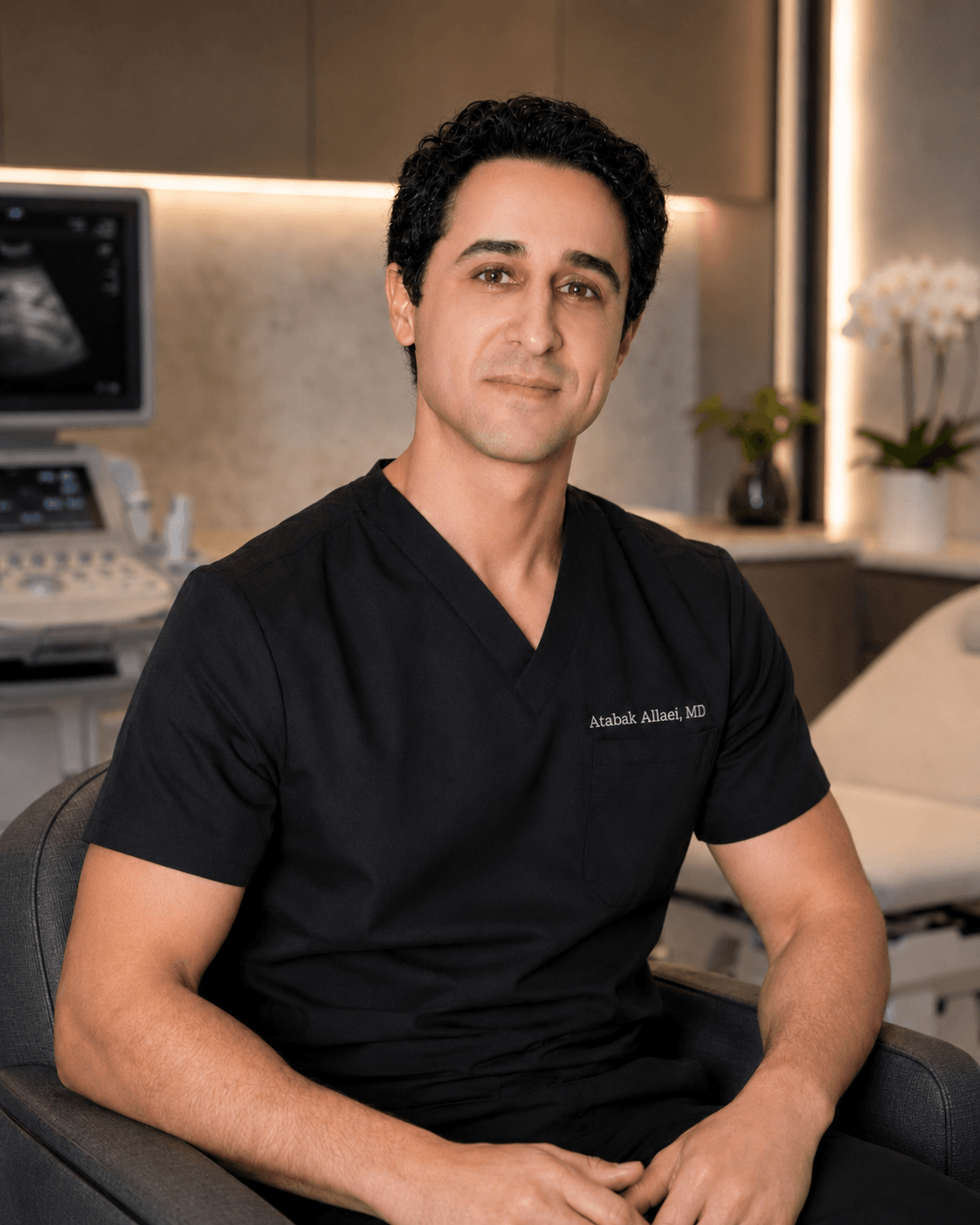
- Double board-certified in Vascular & Interventional Radiology and Diagnostic Radiology
- Attending staff at Cedars-Sinai Medical Center and UCI Health
- More than 5,000 image-guided procedures performed
- Performs both RFA and thyroid artery embolization, including complex and high-risk nodules where position makes ablation technically demanding
Common Questions
What does Bethesda III mean?
Atypia of undetermined significance. Some cells look abnormal, but not enough to classify further. The average malignancy risk is around 22%, with a reported range of 13–30%, so roughly four out of five of these nodules are not cancer. Next steps are usually repeat biopsy, molecular testing, or surgery depending on the subtype and imaging.
What does Bethesda IV mean?
Follicular neoplasm. The cells form a follicular pattern, and cytology cannot separate a benign follicular adenoma from a follicular carcinoma, because that distinction depends on capsular invasion visible only in a removed specimen. Average malignancy risk is about 30%, so most turn out benign.
Do I definitely need surgery for an indeterminate result?
Not necessarily. Diagnostic surgery was the old default, but molecular testing can reclassify many Bethesda III and IV nodules well enough that monitoring becomes reasonable. Ask whether molecular testing is appropriate for your sample before committing to an operation.
Can a biopsy miss cancer?
A needle samples part of a nodule, not all of it, so no biopsy is perfect. That is why the categories carry implied risks rather than certainties, and why follow-up imaging matters even after a benign result. Repeat biopsy is standard if a nodule grows or its appearance changes.
Why do I need two benign biopsies before ablation?
Because ablation destroys the nodule in place and leaves no specimen to examine afterwards. Two concordant benign results substantially reduce the chance of a sampling error, which is the main risk of treating without removing.
References
- Ali SZ, Baloch ZW, Cochand-Priollet B, Schmitt FC, Vielh P, VanderLaan PA. The 2023 Bethesda System for Reporting Thyroid Cytopathology. Thyroid. 2023;33(9):1039–1044.
- Manucha V, Sharma AK, Tabbara SO. Bethesda System for Reporting Thyroid Cytopathology, 3rd edition: simplified terminology and harmonized categories. CAP TODAY. January 2024.
- Implied risk of malignancy by category in the 2023 edition: I 13%, II 4%, III 22%, IV 30%, V 74%, VI 97%, as summarised in the peer-reviewed literature following publication of the third edition.
Get a straight answer about your nodule
Dr. Allaei reviews your ultrasound and biopsy results himself and tells you plainly what you are dealing with, whether a non-surgical option fits, and when surgery is the better answer.