


Is Thyroid RFA Right for You? What Actually Decides It
Radiofrequency ablation shrinks thyroid nodules without an incision — but only for the right nodule in the right person. Here is what your doctor is weighing, including the parts that rule it out.
On this page
Hearing “radiofrequency ablation” for the first time is disorienting. Most people have never heard of it, and it sounds far more complicated than it is. What follows is what actually decides whether it suits your nodule, so you can arrive at your appointment with sharper questions rather than a longer list of worries.
What Thyroid RFA Involves
RFA is a needle-based treatment for thyroid nodules. A thin probe is guided into the nodule using ultrasound and delivers heat that destroys tissue from the inside. The body then clears the treated tissue gradually, and the nodule shrinks over the following months. Nothing is cut, and nothing is removed.
There is no general anesthesia and no hospital stay. Most patients go home the same day with a small bandage on the neck. Because the gland itself stays in place, most people keep normal thyroid function and avoid a lifetime of daily hormone replacement. You can read more about how the procedure works and what a typical visit looks like.
How Much Nodules Actually Shrink
This is the question the general explanations tend to skip, and it matters more than anything else when you are deciding. RFA does not remove a nodule; it shrinks it. In published series, the volume reduction for benign nodules looks like this:
~57%
Median volume reduction at 3 months1
~66%
Median volume reduction at 6 months1,2
~71%
Median volume reduction at 12 months1
Anything above a 50% reduction is generally counted as a successful result.3 Symptom relief tends to track alongside it: in one series, pressure and cosmetic symptoms resolved completely in around two-thirds of patients and partially in the rest.2
Who Fits, and Who Does Not
Candidacy is less a checklist than a balance, but a few factors carry most of the weight.
Usually a good fit
- The nodule has been confirmed benign on biopsy — commonly two separate benign fine-needle aspiration results before ablation
- It is causing real symptoms: pressure in the throat, difficulty swallowing, a visible bulge, or a hoarse voice
- It is small to moderately large, or large enough that a staged approach over two sessions makes sense
- It is a toxic (overactive) nodule producing excess hormone
- You want to avoid an incision, a scar, and the chance of lifelong hormone replacement
- Imaging shows no features suggesting aggressive disease
Usually not the right path
- The nodule is cancerous or suspicious for cancer, and needs management that establishes a full diagnosis
- Biopsy results are indeterminate and the priority is answering that question first
- The nodule sits where it cannot be reached safely — tight against the windpipe, the esophagus, or major vessels
- You would rather have the problem resolved in one procedure than managed over months
- Pregnancy, which postpones most elective procedures
None of the items on the right is necessarily permanent. Several are questions of sequence rather than exclusion — get the diagnosis settled, and RFA may come back onto the table. In selected cases, ablation is used for thyroid cancer too, so it is worth asking about thyroid cancer RFA rather than assuming a cancer diagnosis closes the door.
Why Nodule Type and Size Matter
Type shapes the goal of treatment. A benign solid nodule causing neck pressure is treated to shrink it. A toxic nodule is treated to bring hormone levels back to normal, which is a different target with different follow-up. For overactive nodules specifically, published series report thyroid function returning to normal in roughly three-quarters of patients, and more often when treatment is done across more than one session.4 If that describes you, toxic thyroid nodule RFA is the relevant page.
Cystic and part-cystic nodules generally respond faster than solid ones, because fluid drains readily. Purely solid nodules take longer and shrink somewhat less.
Size shapes the plan. Smaller nodules often shrink well in one session. Large nodules — roughly 20 mL and above — frequently need two, and there is good evidence that scheduling the second session within six months produces meaningfully better shrinkage at a year than a single treatment does (about 76% versus 66%).5 If your nodule is large, being told to expect two sessions is not a sign something went wrong. It is the plan.
All of this is settled before treatment through ultrasound and biopsy. A careful thyroid nodule diagnosis matters here, because treating the wrong problem, or ablating something that needed closer examination, sets your care back.
Health Factors Your Doctor Will Review
Beyond the nodule, your general health shapes how the procedure is planned:
- Current thyroid hormone levels and any history of thyroid disease
- Bleeding disorders, or blood thinners you take
- Previous neck surgery or radiation to the neck
- Allergies to local anesthetic
- Pregnancy status
- Whether you can lie flat with your neck extended for the length of a session
None of these rules anyone out automatically. They determine the safest approach, or whether something should be addressed first.
Honest Limitations and Risks
Any page that describes a procedure without describing its downsides is selling rather than explaining. The limitations worth knowing:
- The nodule does not disappear. A large nodule reduced by 70% is still present, just much smaller. For most people that resolves the symptoms; it is not the same as removal.
- Regrowth is possible. Some nodules regrow over years and need a further session.
- You do not get a full pathology specimen. Surgery removes tissue that can be examined completely. This is precisely why a confirmed benign biopsy comes first.
- Complications are uncommon but real. Pooled data put the complication rate for thermal ablation of thyroid nodules at roughly 4%, mostly minor and temporary — pain, small bruising, or a temporary voice change from irritation of the nearby nerve.4 Permanent voice change is rare, and avoiding it depends heavily on the operator's technique near the nerve.
More detail is on our RFA limitations and risks page.
RFA Compared With the Alternatives
| Thyroid RFA | Surgery | Radioactive iodine | |
|---|---|---|---|
| Incision | None — needle only | Yes, neck incision | None |
| Anesthesia | Local numbing | General anesthesia | None |
| Hospital stay | Same day, outpatient | Often overnight | Outpatient, with precautions |
| The gland itself | Stays in place | Partly or fully removed | Stays, but function falls |
| Result timing | Gradual over 3–12 months | Immediate | Gradual over months |
| Recovery | A day or two | One to two weeks | Days, with radiation precautions |
| Hormone pills after | Rarely | Often, especially after full removal | Often, as function drops |
| Scarring | Minimal to none | Visible neck scar | None |
This is a general guide; your own case may differ. Our fuller comparison chart and the clinical evidence behind these outcomes are both worth reviewing before your appointment.
Cost and Insurance
This belongs in any honest discussion of whether RFA is right for you, because it is often a deciding factor rather than a footnote. Coverage for thyroid RFA varies considerably between insurers and plans, and some carriers apply specific criteria around nodule size, symptoms, and confirmed benign biopsy results before approving it. Ask what your plan requires before you commit to a path — our insurance page covers how we handle this, and the office can check your benefits directly.
What Happens at an Appointment
An appointment is where the general turns specific. Your doctor reviews your imaging, goes through biopsy results if you have them, examines your neck, and asks about symptoms and history. You should leave knowing whether you are a candidate, how many sessions to expect, and what shrinkage is realistic for your particular nodule.
Bring your ultrasound report and biopsy results if you have them. A specialist who is straightforward about the limits of RFA, and who will tell you when surgery is the better answer, is the one worth listening to.
Questions worth asking
- What is my nodule's volume in millilitres, and what reduction is realistic for it?
- Will this need one session or two?
- How close is the nodule to the recurrent laryngeal nerve, and how do you protect it?
- What happens if it regrows?
- How many of these have you performed?
Who Performs Thyroid RFA
RFA is an image-guided procedure, which means the operator’s ultrasound skill is not a detail — it is the procedure. Published work on RFA outcomes finds that results improve measurably with operator experience and stabilise after roughly twenty cases.1 Experience is a fair thing to ask about.
California Thyroid Center
A practice focused on image-guided thyroid treatment rather than one offering it alongside everything else. Appointments are conducted by the physician himself, including reviewing your imaging with you.
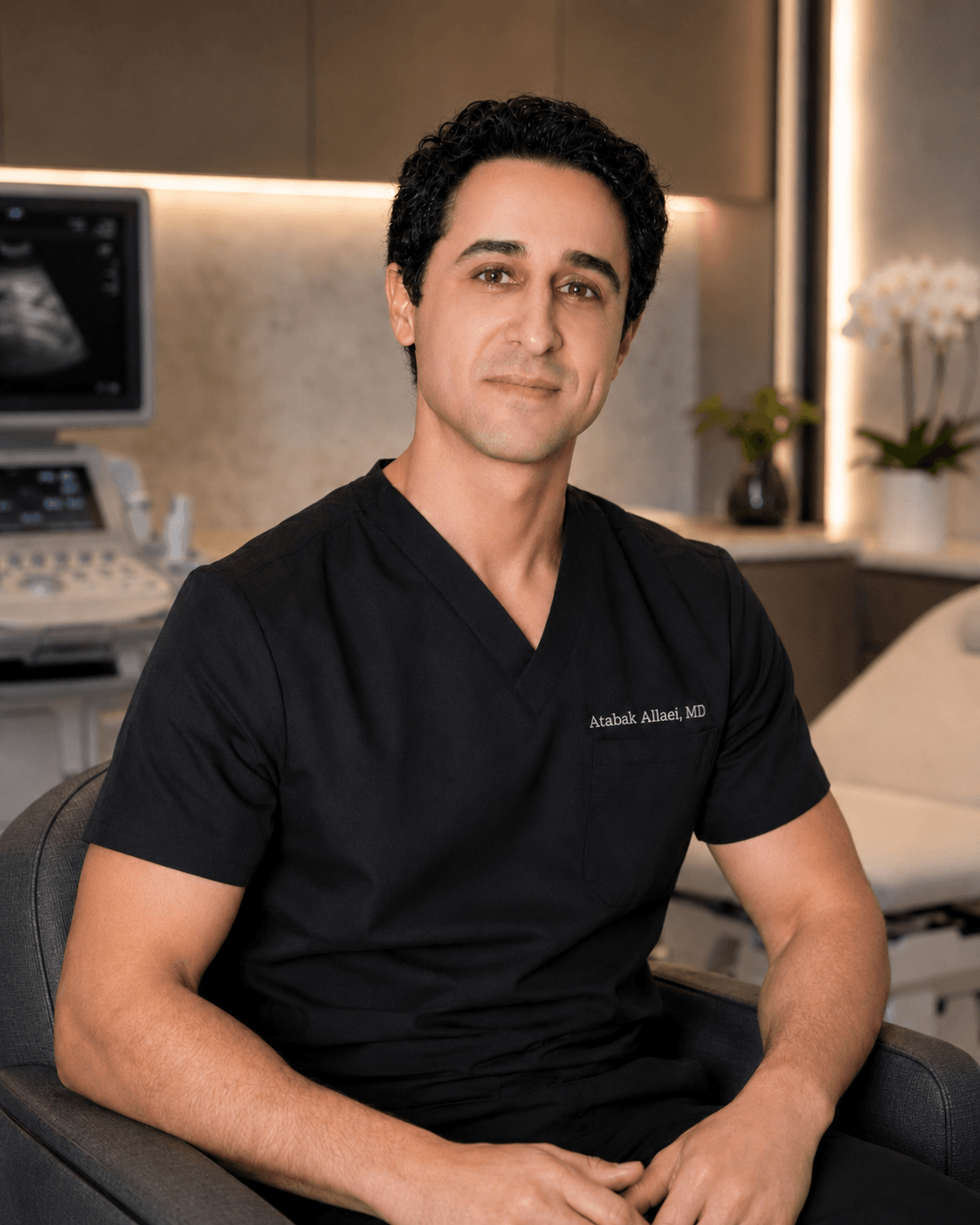
- Double board-certified in Vascular & Interventional Radiology and Diagnostic Radiology
- Attending staff at Cedars-Sinai Medical Center and UCI Health
- More than 5,000 image-guided procedures performed
- Experienced in complex and high-risk nodules where positioning makes ablation technically demanding
Common Questions
How do I know if my nodule qualifies for RFA?
You need an ultrasound and, in nearly all cases, a biopsy confirming the nodule is benign. Those two together establish its size, position, composition, and whether ablation is appropriate. Most specialists want two separate benign biopsy results before ablating a solid nodule.
How much will my nodule shrink, and how fast?
In published series, median volume reduction is roughly 57% at three months, 66% at six, and 71% at twelve. Anything over 50% counts as a successful outcome. Nothing visible changes on the day — shrinkage is gradual, and most of it occurs in the first six months.
Does thyroid RFA hurt?
Most people feel pressure and warmth rather than sharp pain. The area is numbed with local anesthetic beforehand, and the discomfort is commonly described as comparable to a dental procedure. Some neck soreness for a day or two afterwards is normal.
Will I need thyroid hormone medication afterwards?
Usually not. RFA targets the nodule and leaves the surrounding healthy gland intact, so thyroid function typically continues normally. This is the main practical difference from removal of the gland, which nearly always requires daily hormone replacement for life.
Can a large nodule still be treated?
Yes. Nodules of roughly 20 mL and above often need two sessions rather than one, and evidence suggests scheduling the second within six months produces better shrinkage at a year than a single session. Size alone does not rule out treatment.
Can the nodule grow back?
It can. Some nodules regrow slowly over years, and a further ablation session can be performed if that happens. Follow-up ultrasound is how it is monitored, and this is worth discussing before treatment rather than after.
How soon can I return to normal activity?
Most people resume light activity the next day. Heavy lifting and strenuous exercise are usually avoided for about a week while the treated area settles.
References
- Radiofrequency Ablation for Thyroid Nodules (RATED Study) — Analysis of a Learning Curve and Predictors of Success. J Clin Endocrinol Metab. 2025;110(11):3201. Median volume reduction 57.1%, 65.6%, and 70.8% at 3, 6, and 12 months.
- Predictor Analysis in Radiofrequency Ablation of Benign Thyroid Nodules: A Single Center Experience. Median volume reduction 61.2% at 6 months and 67.6% at 12 months; symptom resolution complete in 64.4% and partial in 35.7%.
- Therapeutic success in thyroid nodule ablation is conventionally defined as volume reduction greater than 50%.
- Cigna medical coverage policy: Radiofrequency Ablation of Thyroid Nodules — summarising pooled outcomes for autonomously functioning nodules (12-month volume reduction 77.2%; TSH normalisation 76.4%) and a thermal ablation complication rate of 3.8%.
- Early second radiofrequency ablation treatment gave rise to significantly greater nodule shrinkage at 12 months than single-session treatment for large-volume benign thyroid nodules. Surgery. 2024. 12-month volume reduction 75.6% with two sessions versus 65.9% with one.
This article is for general education and does not replace an evaluation by a qualified physician. Individual results vary. See our disclaimer.
Find out whether your nodule is a candidate
Dr. Allaei reviews your ultrasound and biopsy results himself and tells you plainly whether RFA suits your nodule, how many sessions it would take, and what shrinkage is realistic — including when surgery is the better answer.